> ## Documentation Index
> Fetch the complete documentation index at: https://docs.anymorph.ai/llms.txt
> Use this file to discover all available pages before exploring further.
# Content settings
> Manage writing guidelines, learned editing rules and non-public sources for each content lane
**On-site settings** and **Off-site settings** control how later content is written. Open them from the settings button on the corresponding content list. Each has its own guidelines and **Memory**; brand facts remain in [Knowledge](/dashboard/knowledge).
 ## What's on the screen
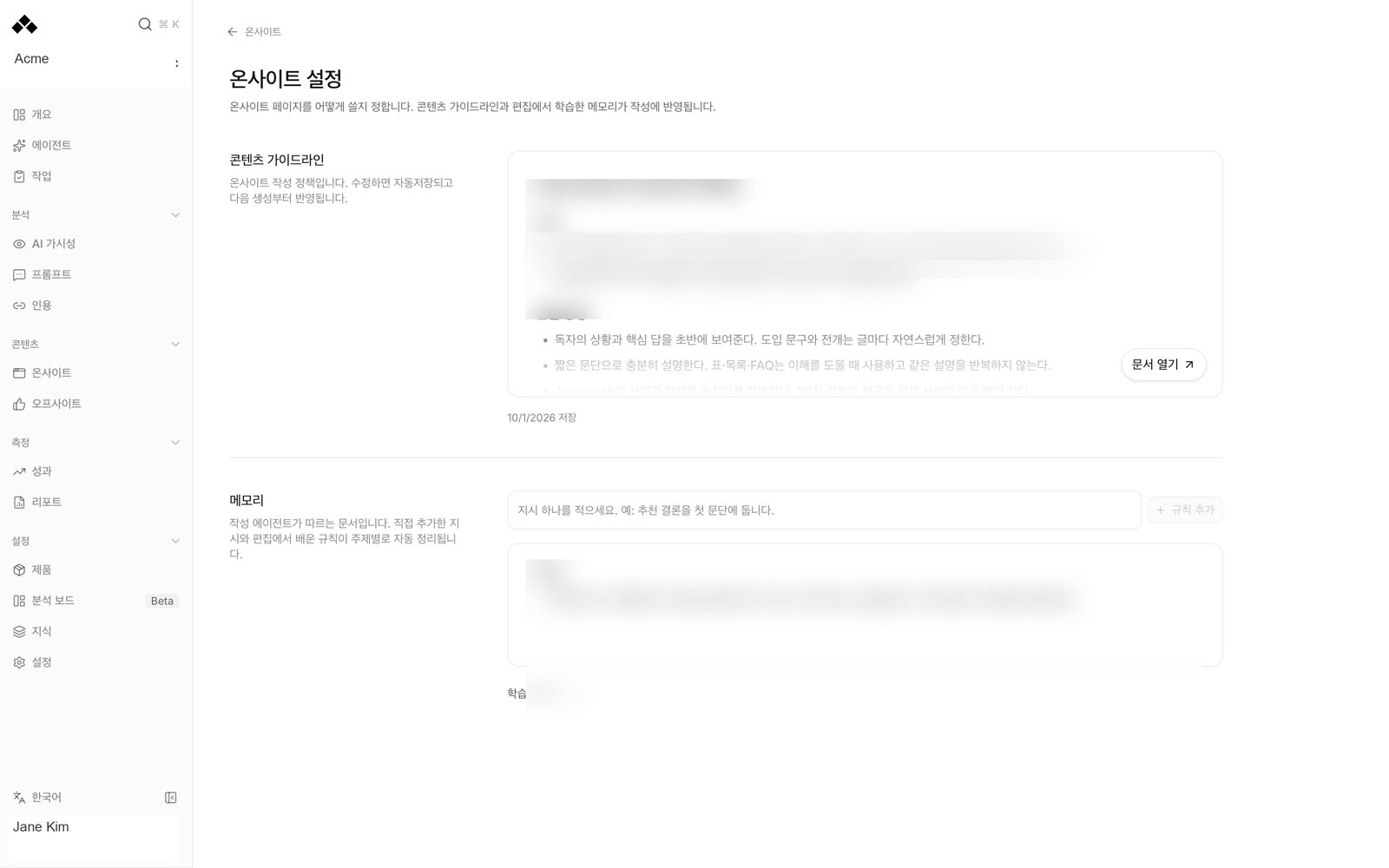
### Guidelines
**Content guidelines** controls writing on your own site. **Off-site guidelines** controls third-party writing on external channels. Put rules specific to a channel under that channel's heading in the off-site document.
Choose **Open document** to read or edit the guidelines. The document opens in the dashboard language when translation is needed. Use **Show original** to inspect the stored wording; editing takes place in the original. The assistant stays beside the document so you can ask for changes without leaving the page.
Guidelines save automatically and apply from the next generation. There is no separate approval step to activate an autosaved rule. Wait for the saved status before leaving. If a document exceeds its limit, the warning means your latest text is not being saved; shorten it first.
### Memory
**Memory** shows the document the writer follows, organized by topic. It combines instructions you add and rules learned from saved edits. New learned rules apply without a separate confirmation button.
Write a short, reusable instruction and press **Add rule**. Examples: “Put the recommendation in the first paragraph” or “Use this approved phrase for the delivery policy.” A rule should describe what future drafts must do, rather than a one-time correction on a single page.
The main document holds general instructions. **Only on pages about** lists rules specific to a named product or company; the writer applies them when the page mentions that subject. **Terminology** holds word-for-word replacements and includes them with every page.
**Learning history** lists the underlying **Written** and **Learned from edits** rules. **Show edits** opens the before-and-after examples behind a learned rule. An example can illustrate a judgment without being text to copy, or be marked as a word-for-word replacement.
Turn a rule off when it should no longer guide the writer. It moves to **Turned off** and leaves the next run's instructions. Turning a rule off does not rewrite existing published content.
Saved page edits and later generation are separate events. Check **Learning history** and the current Memory document to confirm a pattern has become a rule. Editing one page is not proof that every later page will repeat your correction.
### Non-public domains
**Non-public domains** protects internal source addresses from appearing in public content. Add a host or a page address; the host and its subdomains are excluded from research, citations and links across both content lanes. Their material can still serve as internal background.
For example, if your internal guide lives on a private help host, add that host before using the guide as background. Do not put a public source here merely because you dislike its writing style; the setting changes whether the writer can cite or link it.
## Choose the right place for a correction
| Correction | Where it belongs |
| - | - |
| Brand, pricing or product fact | **Brand.md**, or the product's confirmed source facts |
| Writing structure and tone for a lane | That lane's guidelines |
| A short recurring editing judgment | **Memory** |
| An internal address that must not appear publicly | **Non-public domains** |
| A typo on one already published page | That page's editor, followed by its update process |
A broad instruction can affect many future pages. Keep it specific, factual and consistent with the other rules. “Never make mistakes” cannot guide a writer; an approved term, a required qualification or a concrete layout instruction can.
## How to use it
Open **On-site settings** from On-site or **Off-site settings** from Off-site. The memories are separate.
Inspect the guidelines and Memory document before adding a rule. Check for an existing rule that already covers the issue.
Edit the guidelines or use **Add rule**. Wait for the saved state. Review **Show edits** if the instruction was learned from a correction.
Read the next generated draft to verify the intended behavior. An existing draft is not automatically rewritten by a settings change.
## FAQ
No. The writer's Memory is rebuilt as rules are learned, added or turned off. Read the current document to see what it follows.
Each lane has its own guidelines and Memory. Both lanes share brand facts and non-public domain protection.
Turn it off in **Learning history**. Existing pages remain unchanged.
Rules under **Only on pages about** apply when the page names their subject. General rules apply throughout that lane.
No. Translation is for reading. Open **Show original** to inspect and edit the stored document.
Read the length warning and shorten it. The saved indicator, not the fact that text is visible, confirms storage.
## Related
Correct the facts used by both lanes.
Turn a page correction into a reusable instruction.
Edit and review one draft.
Read translations without changing originals.
## What's on the screen
### Guidelines
**Content guidelines** controls writing on your own site. **Off-site guidelines** controls third-party writing on external channels. Put rules specific to a channel under that channel's heading in the off-site document.
Choose **Open document** to read or edit the guidelines. The document opens in the dashboard language when translation is needed. Use **Show original** to inspect the stored wording; editing takes place in the original. The assistant stays beside the document so you can ask for changes without leaving the page.
Guidelines save automatically and apply from the next generation. There is no separate approval step to activate an autosaved rule. Wait for the saved status before leaving. If a document exceeds its limit, the warning means your latest text is not being saved; shorten it first.
### Memory
**Memory** shows the document the writer follows, organized by topic. It combines instructions you add and rules learned from saved edits. New learned rules apply without a separate confirmation button.
Write a short, reusable instruction and press **Add rule**. Examples: “Put the recommendation in the first paragraph” or “Use this approved phrase for the delivery policy.” A rule should describe what future drafts must do, rather than a one-time correction on a single page.
The main document holds general instructions. **Only on pages about** lists rules specific to a named product or company; the writer applies them when the page mentions that subject. **Terminology** holds word-for-word replacements and includes them with every page.
**Learning history** lists the underlying **Written** and **Learned from edits** rules. **Show edits** opens the before-and-after examples behind a learned rule. An example can illustrate a judgment without being text to copy, or be marked as a word-for-word replacement.
Turn a rule off when it should no longer guide the writer. It moves to **Turned off** and leaves the next run's instructions. Turning a rule off does not rewrite existing published content.
Saved page edits and later generation are separate events. Check **Learning history** and the current Memory document to confirm a pattern has become a rule. Editing one page is not proof that every later page will repeat your correction.
### Non-public domains
**Non-public domains** protects internal source addresses from appearing in public content. Add a host or a page address; the host and its subdomains are excluded from research, citations and links across both content lanes. Their material can still serve as internal background.
For example, if your internal guide lives on a private help host, add that host before using the guide as background. Do not put a public source here merely because you dislike its writing style; the setting changes whether the writer can cite or link it.
## Choose the right place for a correction
| Correction | Where it belongs |
| - | - |
| Brand, pricing or product fact | **Brand.md**, or the product's confirmed source facts |
| Writing structure and tone for a lane | That lane's guidelines |
| A short recurring editing judgment | **Memory** |
| An internal address that must not appear publicly | **Non-public domains** |
| A typo on one already published page | That page's editor, followed by its update process |
A broad instruction can affect many future pages. Keep it specific, factual and consistent with the other rules. “Never make mistakes” cannot guide a writer; an approved term, a required qualification or a concrete layout instruction can.
## How to use it
Open **On-site settings** from On-site or **Off-site settings** from Off-site. The memories are separate.
Inspect the guidelines and Memory document before adding a rule. Check for an existing rule that already covers the issue.
Edit the guidelines or use **Add rule**. Wait for the saved state. Review **Show edits** if the instruction was learned from a correction.
Read the next generated draft to verify the intended behavior. An existing draft is not automatically rewritten by a settings change.
## FAQ
No. The writer's Memory is rebuilt as rules are learned, added or turned off. Read the current document to see what it follows.
Each lane has its own guidelines and Memory. Both lanes share brand facts and non-public domain protection.
Turn it off in **Learning history**. Existing pages remain unchanged.
Rules under **Only on pages about** apply when the page names their subject. General rules apply throughout that lane.
No. Translation is for reading. Open **Show original** to inspect and edit the stored document.
Read the length warning and shorten it. The saved indicator, not the fact that text is visible, confirms storage.
## Related
Correct the facts used by both lanes.
Turn a page correction into a reusable instruction.
Edit and review one draft.
Read translations without changing originals.