

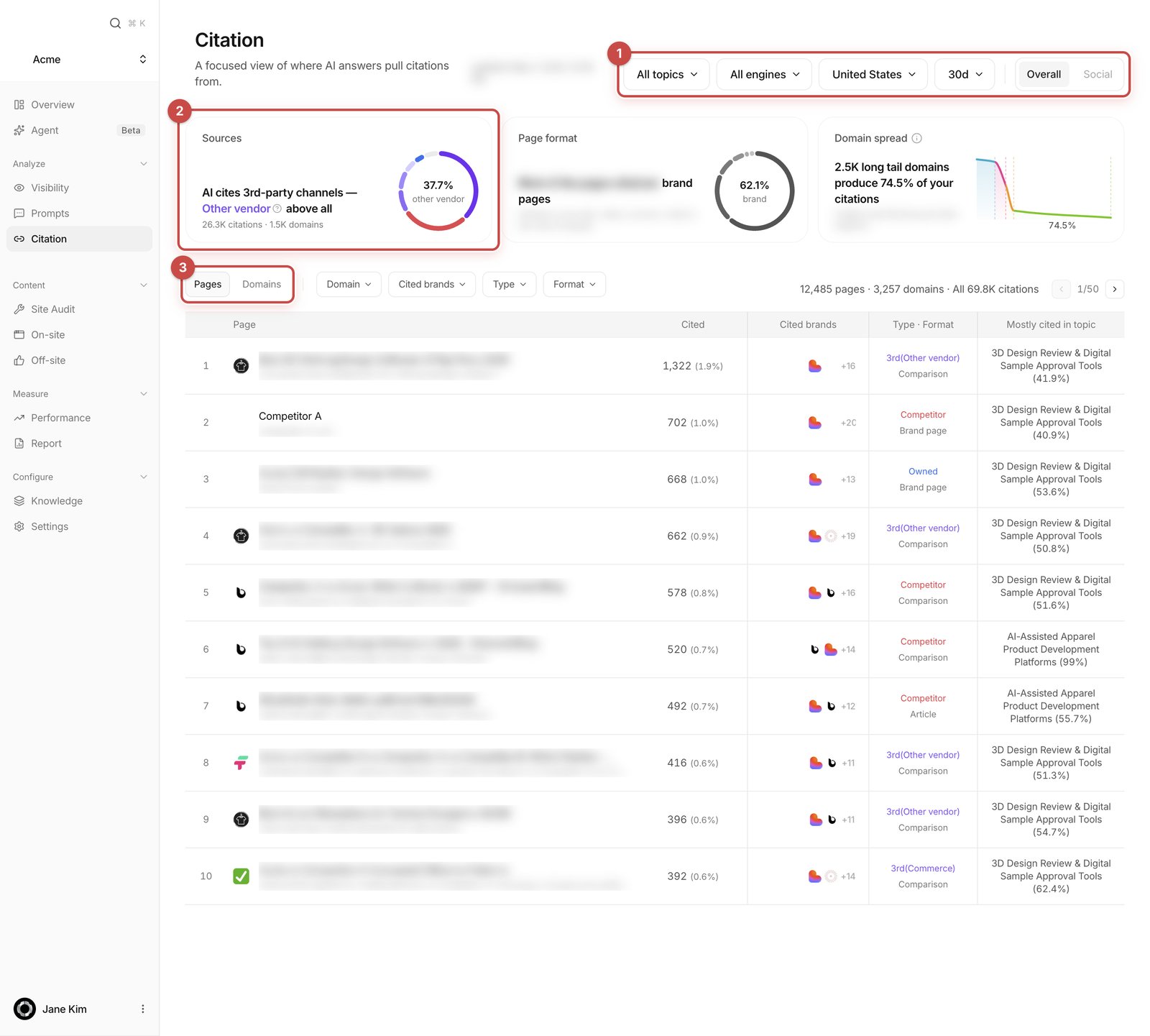
- Filters — topics, AI engine (All engines), region, period (7d / 30d / 60d / 90d), and the Overall · Social tabs.
- Sources — one sentence on what AI cites most. Page format and Domain spread sit beside it.
- Pages / Domains grain pills and the cited pages table.
Citation is not mention
Get this distinction first and the rest of the page reads easily.- A mention is your brand being named in the answer text. That lives in Visibility.
- A citation is one source link attached to one AI answer. If the same page is cited in 40 answers, it counts 40 times.
What’s on the screen
Filters
The controls sit at the top right. The topic filter only appears on the Overall tab, and only lists topics the selected region actually measures. Pick an engine from All engines to scope the whole page to that engine. The period defaults to 30 days. The region select only shows up for workspaces that measure more than one region. Changing a filter doesn’t reload the page, and a scope you already looked at comes straight back for a few minutes. Overall and Social are two different views, not filters.The three cards
Sources answers “what does AI cite most?” in a sentence — for example that third-party channels lead, with Editorial above all. Under it you get[N] citations · [N] domains, and the donut shows the full source-type mix. Hover a type to see its definition.
Page format tells you what shape the cited pages are: Article, Forum / Q&A, Comparison, Guide / docs, News / PR, Pricing, Brand page, Research, Video, Social post. It’s the fastest way to decide what kind of content to make next.
Domain spread shows how big the cited sites are. Size is the site’s Chrome popularity rank.
This measures how big the site is on the open web, not how much it cites you. The card also gives you the play: pitch Mega domains by name, shortlist the Large domains that keep recurring, and address the long tail by publishing something many of them can cite.
Source types
The Type classification says who owns a domain and what kind of site it is. In the table it prints as3rd(Reviews) so the bucket survives.
Other 3rd-party is often the single biggest slice. Because it names no actual source, it is never picked as the leading type in the headline — but it still draws in the donut.
The cited pages table
Pages gives you one row per URL, Domains one row per domain. The filters beside them are Domain (single-select, top 25), Cited brands (multi-select), Type, Format and Scale. A Clear button appears once anything is filtered. At the right end you get[N] pages · [N] domains · All [N] citations and a pager.
The Pages columns:
The shares in Cited brands won’t add up to the citation count. One answer naming three brands credits all three, so that column describes co-occurrence, not citations.
The evidence drawer
Click any row and a drawer opens on the right.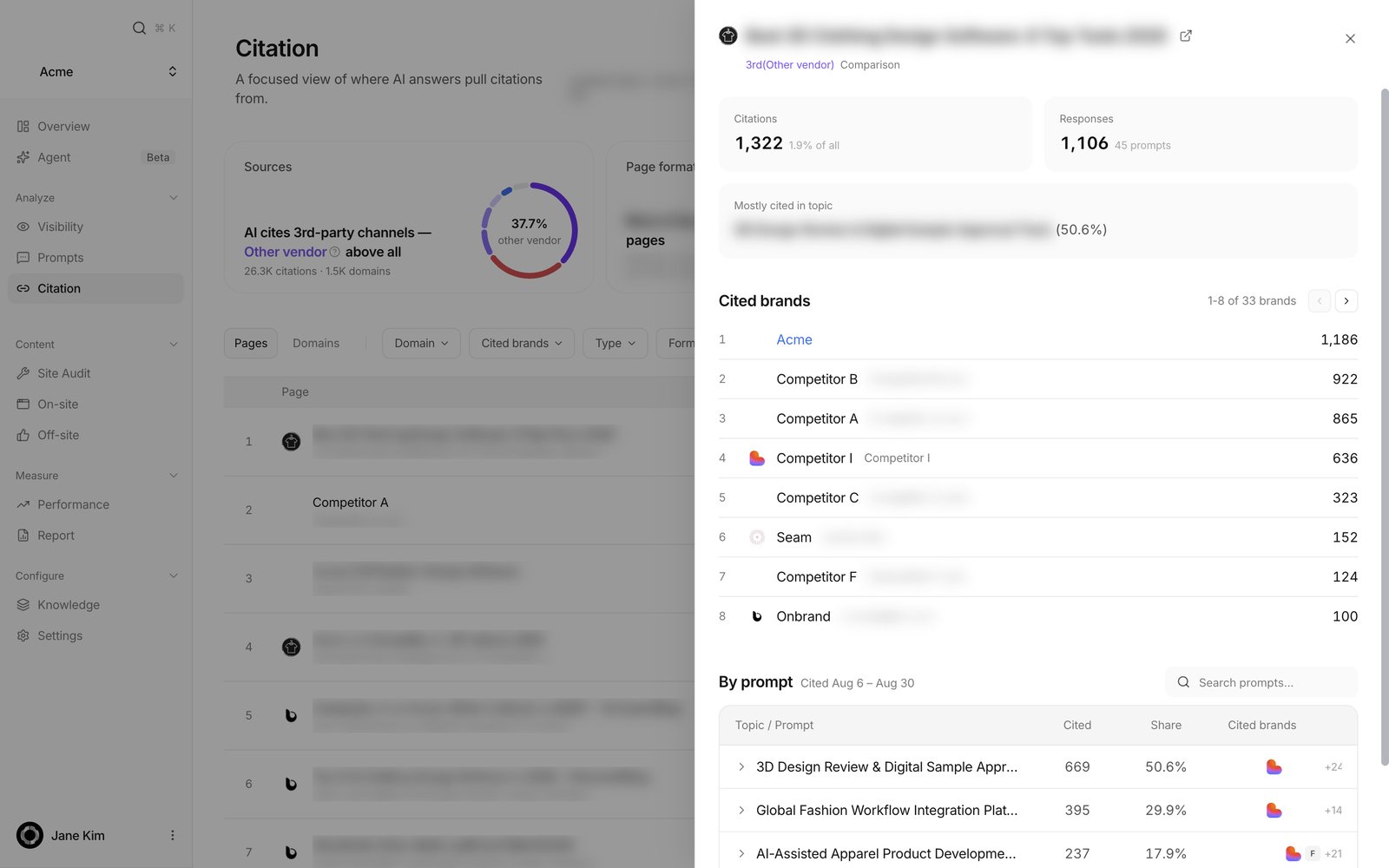
The Social tab
This view is about creators — the people shaping what AI says about your category. Creator overview has three donuts. Share of voice shows, when a creator names a brand, how often it’s you versus a competitor (You / Competitors). By platform shows where creator citations come from (YouTube / Instagram / TikTok). By size splits citation share by follower tier: Nano (under 10K), Micro (10K–100K), Macro (100K–1M), Mega (1M+), Unknown. Top 10 creators to win lists creators who cite a competitor but never you — your seeding shortlist. Expand it for rank, name, platform, handle, followers, citation count and an Open channel link. The creators list below has a “Search creators…” box, platform pills (All / YouTube / TikTok / Instagram) and lens pills (All / Ours / Competitor-only). Expand a row to see that creator’s cited content.How to use it
1
Find where to get placed
Set the period and engine, then filter the table by the leading Type the Sources card named (Editorial, Reviews, Social, whichever it is). Work down by Cited, open a row’s evidence drawer to confirm it’s cited for prompts you care about, then take that domain into Off-site work.
2
Check how your own site is doing
Open the Type filter and tick Owned domains only. Your pages get re-ranked against each other, so you see the ones that would never survive the global top list.
3
Go from a publication to its individual pages
Switch the grain pill to Domains to rank publications, pick one in the Domain filter, then switch back to Pages to see that publication’s pages.
4
Build a creator shortlist
On the Social tab, expand Top 10 creators to win and open each channel. For the full list, use the Competitor-only lens pill in the creators list.
FAQ
Why is my own site cited so little?
Why is my own site cited so little?
AI answers overwhelmingly cite third parties. Owned share is the fraction of all cited links pointing at your domains, and on a normal workspace that’s a few percent. Tick Owned domains in the Type filter to rank your own pages against each other instead.
Why don't citations match my mention numbers?
Why don't citations match my mention numbers?
They count different things: links attached to answers versus your brand being named in the answer text. A page can be cited in an answer that never mentions you.
The card total and the table total differ slightly.
The card total and the table total differ slightly.
The cards read a deduplicated daily copy of the data; the table reads the raw citation records. Different paths, so small gaps happen. The count above the table is the true total for your filters — the rows on screen are only the top few hundred pages.
What is Other 3rd-party?
What is Other 3rd-party?
The catch-all for domains that matched none of the known categories. It’s often the largest slice, and it’s deliberately never named as the leading source type because it doesn’t name an actual kind of source.
The Cited brands percentages don't add up to the citation count.
The Cited brands percentages don't add up to the citation count.
That column measures which brands appeared in the same answers. One answer naming three brands credits all three, so those shares describe co-occurrence, not citations.
Does Long tail mean small sites, or sites that rarely cite me?
Does Long tail mean small sites, or sites that rarely cite me?
Site size. It means a popularity rank past a million on the open web, and says nothing about how often that site cites you.
My topic filter disappeared when I switched region.
My topic filter disappeared when I switched region.
Topics are set per region. A topic the new region doesn’t measure gets dropped, and the page returns to the unfiltered view rather than showing you an empty one.
Nothing shows at all — is it broken?
Nothing shows at all — is it broken?
Either no citations have been captured for this scope yet, or the source data is being verified. Widen the period, clear the engine and topic filters, and try again later. A real failure looks different: the screen says Couldn’t load citation data with a Try again button, and that message means the request failed, not that there are no citations.
Can I export this?
Can I export this?
No. There’s no download on this screen today.
Related
Visibility
How often your brand is named in AI answers.
Off-site
Turn the domains you find here into placements.
On-site
Use the cited page formats to shape your own pages.
Reading the numbers
How the metrics fit together.